
Difficulty: Intermediate – Power User
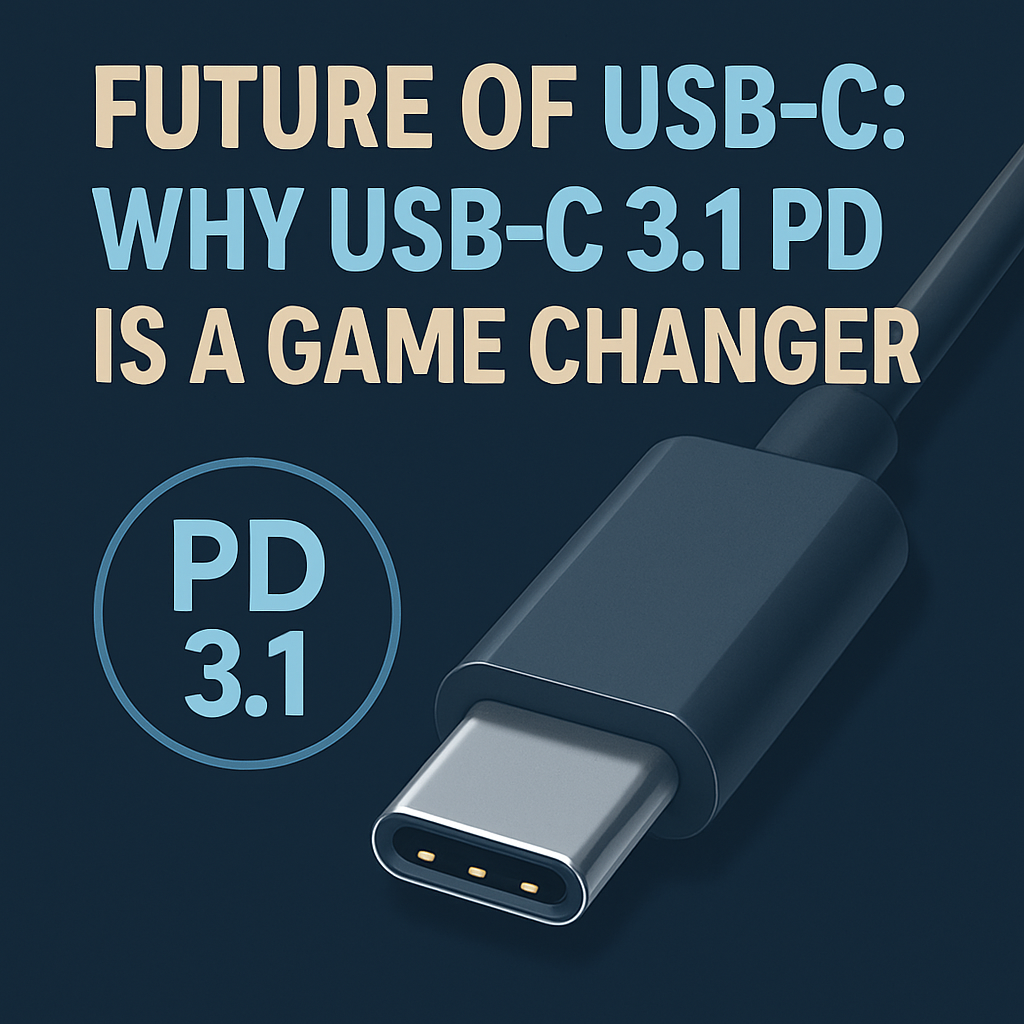
The rapid adoption of usb-c 3.1 pd marks one of the strongest turning points in modern device charging. For the first time, USB-C can safely deliver up to 240W of power—enough to replace bulky laptop bricks, power high-resolution monitors, and support next-generation workstation hardware. This upgrade pushes USB-C closer to becoming the single universal connector the industry has been working toward for years.
⭐ Key Takeaway
USB-C 3.1 PD expands power delivery from 100W to 240W, allowing powerful laptops, monitors, and future devices to run through one universal USB-C cable.
What USB-C 3.1 PD Actually Is (Definition Box)
USB-C 3.1 Power Delivery is an enhanced charging standard that:
- Raises max charging output to 240W
- Supports new voltage profiles: 28V, 36V, 48V
- Works with certified EPR (Extended Power Range) cables
- Improves power negotiation and safety checks
The USB-IF states that these improvements enable USB-C to support “virtually all portable computers,” eliminating the need for brand-specific power connectors.
How the New USB-C PD 3.1 Power Levels Work
To deliver more power safely, PD 3.1 introduces extended voltage stages:
Standard Power Range (SPR)
- 5V–20V
- Up to 100W
- Used by phones, tablets, and ultrabooks
Extended Power Range (EPR)
- 28V (140W)
- 36V (180W)
- 48V (240W)
These new voltage levels allow devices like gaming laptops and professional monitors to run at full performance through USB-C alone.
Why Higher-Powered USB-C Charging Matters
1. Powerful Laptops Can Use USB-C Only
Before this upgrade, many laptops needed 150W–230W proprietary chargers.
With usb-c 3.1 pd, the same machines can finally run on USB-C.
2. True One-Cable Monitor Setups Become Reality
A single USB-C cable can now deliver:
- Display output
- Data
- Ethernet (via dock)
- Full power
This is ideal for home offices, creators, and productivity setups.
3. Universal Charging Reduces E-Waste
A study from the UN Global E-Waste Monitor shows that over 50 million tons of e-waste is generated yearly.
Stricter USB-C standardization greatly reduces redundant chargers.
4. Safer Fast Charging
PD 3.1 adds:
- Cable authentication
- Temperature monitoring
- Over-current protection
- Automatic downgrade if unsafe conditions occur
Devices That Will Benefit the Most
Already adopting PD 3.1:
- Professional laptops (workstations)
- Portable 4K monitors
- USB-C docks and hubs
- Creator laptops
- High-brightness displays
Likely future adopters:
- VR/AR headsets
- USB-C powered smart TVs
- External GPU enclosures
- Industrial tablets
- High-power camera equipment
As manufacturers shift to usb-c 3.1 pd, multi-charger setups will gradually disappear.
⭐ Quick Fix Box
If your device isn’t charging at high wattage:
- Use a certified USB-C EPR (48V/5A) cable
- Confirm the charger supports PD 3.1 / 240W
- Avoid low-quality third-party cables
Most charging issues come from incompatible cables.
Common Problems & Fixes
1. Device charges but not at full speed
Cause: Using a Standard Power Range cable
Fix: Switch to a USB-IF certified EPR cable
2. Charger shuts off temporarily
Cause: Negotiation or safety fault
Fix: Replace cable or use a lower voltage profile
3. Laptop drains battery during gaming
Cause: Device capped at 140W–180W input
Fix: Check device wattage specification
4. Monitor flickers on USB-C power
Cause: Cable cannot handle video + high-power simultaneously
Fix: Use a high-bandwidth, EPR-rated cable
FAQ
1. What makes usb-c 3.1 pd different?
It increases USB-C power delivery to 240W and adds safer, more stable voltage profiles.
2. Do all USB-C cables support PD 3.1?
No. Only EPR-rated cables can handle the full wattage.
3. Will it replace laptop bricks?
For most models, yes. Many brands are already transitioning.
4. Is USB-C 3.1 PD safe?
Yes. It uses cable authentication, voltage monitoring, and thermal protection.
5. Is it backward compatible?
Absolutely. It safely steps down for lower-power devices.
6. Can gaming laptops use it?
Yes — especially models requiring 140W–180W.