

Latency refers to the delay between an action and its response in a network or system. Understanding latency explained is essential because high latency can ...
 The Tech wizard

Ethernet is often worth using for work-from-home setups because it provides a stable, low-latency internet connection that avoids common Wi-Fi problems like ...

The best Wi-Fi channel width depends on your environment and device density. In most homes, 20 MHz works best for 2.4 GHz, while 40–80 MHz works best for 5 ...

Changing DNS rarely increases your actual internet bandwidth, but it can reduce website loading delays and improve browsing responsiveness. Faster DNS servers ...

A LAN cable (wired connection) provides faster, more stable, and lower-latency internet — ideal for video calls, large file uploads, and online meetings. WiFi ...

5GHz Wi-Fi delivers higher speeds but shorter range because higher-frequency radio waves lose energy faster and struggle to pass through walls. Placement, ...
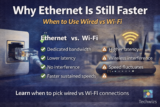
Ethernet remains faster than Wi-Fi because it provides a dedicated, interference-free connection with lower latency and consistent speeds. Although modern ...